Chasing a 5% Ghost: When a Good Result Lies
Somewhere out in the field, about 5% of an 1800-unit Raspberry Pi CM3+ fleet would crash — but only after a very specific event: losing and regaining their 4G connection. When it happened, the unit often didn’t just reboot. It became unusable: powered but unreachable, sometimes stuck at the bootloader, needing a technician to physically swap it.
Five percent. After a network blip. On otherwise-healthy hardware. This is the story of chasing that ghost down to the millivolt — and of the moment a beautiful, tempting fix turned out to be a lie.
The shape of the problem
The symptoms formed an odd constellation:
- Only ~5% of units, seemingly at random.
- Always correlated with a 4G disconnect/reconnect.
- After the crash: “powers up, nothing happens,” or “stuck at boot with some numbers,” or “takes forever, so we just swap it.”
A power event doesn’t care about your network state. A fault that fires specifically on modem reconnection smells like software — or like something electrical that the modem’s radio activity triggers. The earliest clue was a field power-meter capture showing the 3.3 V rail briefly collapsing toward 2.5 V. Suspicious. But a 1 Hz power meter aliases fast transients, and correlation isn’t cause. I needed to reproduce it on the bench.
Dead end #1: a healthy board refuses to break
I put a known-good board on the bench and hammered the modem: 100 radio
power-cycles, then full modem cold-reboots (AT+CFUN=1,1, which drops the
device off USB and re-enumerates it — the biggest inrush event you can ask a
modem for). I watched the 3.3 V rail the whole time.
Nothing. Not a single dip below 3.2 V. I stacked on CPU, memory, and USB disk load. The rail sagged a whopping 70 mV under everything I threw at it. On the bench, with no antenna, the board’s power delivery looked excellent.
That sent me down a wrong turn: maybe the failing units are simply worse boards. It’s the obvious hypothesis — a bad-hardware subset would neatly explain a 5% rate. Hold that thought; it turns out to be exactly the wrong frame, and seeing why is the whole point of this story.
Building a rig that tells the truth
The power meter wasn’t good enough. I moved to a Digilent Analog Discovery 3
— a USB oscilloscope with a scriptable SDK — driven from Python on macOS. (One
yak-shave worth noting: the WaveForms SDK couldn’t find the device until I
symlinked the framework it ships inside the app bundle to where the runtime
expects it, /Library/Frameworks/dwf.framework. After that, headless capture
just worked.)
With two analog channels I could probe two rails at once and finally map the whole power tree on the carrier board:
| Rail | Idle | Under load | Verdict |
|---|---|---|---|
| +12V input | 12.15 V | −31 mV | rock solid |
| +5V (USB/peripheral) | 5.02 V | −65 mV | load-sensitive |
| +5V standby | 5.03 V | ~0 mV | quiet |
| +3.3V (SoC/IO) | 3.42 V | steady | well-regulated |
| +1.2V (core/DDR) | 1.196 V | −6 mV | rock solid |
| +1.8V | 1.835 V | −21 mV | solid |
Every rail on the good board was healthy. The most load-sensitive point was the +5V USB path — which is exactly where the cellular modem draws its current. A clue, not a culprit. Yet.
Method. Throughout, the measured quantity is the minimum voltage of a rail over a defined window, captured at 100 kSa/s on the Analog Discovery (channel referenced to board ground at the rail’s test point). The first acquisition buffer after each reconfigure is discarded to avoid a settling artefact. Every experiment compares a treated condition against a matched control on the same board, and the firmware under-voltage alarm (
hwmon .../in0_lcrit_alarm) is logged alongside as an independent check.
The breakthrough: it’s not the board, it’s the margin
My first instinct was that the failing units were somehow worse — degraded caps, a weaker regulator, wear. So I compared boards. Newer boards were indeed quieter at idle (~38 mV of +3.3 V ripple) than well-used ones (closer to ~90 mV). Tempting story: aging.
But it didn’t hold. When I ran the modem-reset test, every board dipped — new and old alike. The newer boards started from a quieter baseline, yet the modem reconnect still pulled their +3.3 V rail down by hundreds of millivolts, right alongside the older ones. This was never a bad-board subset. It’s a rail design-margin problem that affects the whole fleet: the +3.3 V rail simply sits too close to the SoC’s brown-out threshold to absorb the modem’s reconnect inrush with room to spare.
That reframes the entire question. If all boards dip, why do only ~5% crash? The answer — which the rest of this post nails down — is coincidence: the dip alone is survivable; it only crashes when it lands at the same instant as another current-drawing operation.
The antenna: with vs. without
Here’s a subtlety that matters, and it’s the part I most want to compare head-to-head. My bench modem initially had no antenna — it registered on no network and, crucially, never transmitted. That means it never drew the big RF power-amplifier current that a real, transmitting modem pulls when it re-registers on a tower after a dropout.
So I ran the modem-reset test twice: once with no antenna, and once with an antenna attached and the modem actually registered on a live network (real RF-TX current during each reconnect).
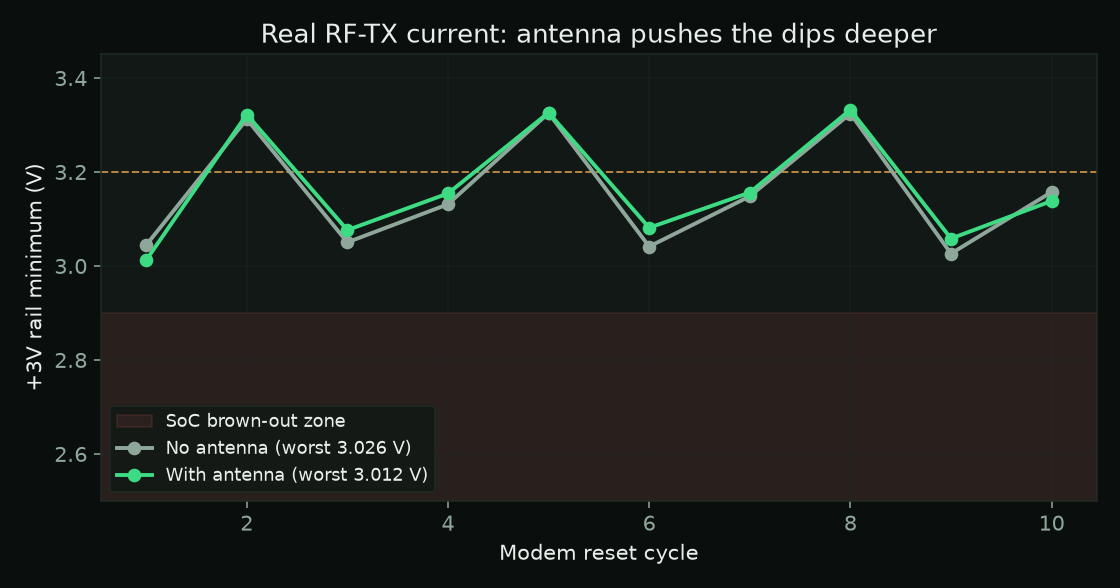
| Condition | Dips (of 10) | Worst +3V |
|---|---|---|
| No antenna | 7 | 3.026 V |
| With antenna | 7 | 3.012 V |
The antenna consistently added another 15–30 mV of sag on the deepest cycles. On its own that sounds tiny — but it’s directional and it’s real: the RF-TX registration burst is genuine extra load on the rail, and it reliably walks the minimum down, toward the edge. Without the antenna I could characterize the mechanism; with the antenna I could see the last stressor the field actually applies.
The no-antenna test is not a throwaway. It isolates the modem’s digital/USB inrush from its RF inrush. The gap between the grey and green traces above is, quite literally, the current cost of talking to a cell tower — measured at the rail.
Isolating the variable: a controlled experiment
At this point I had a strong suspicion but not a clean proof. The honest objection to everything above is confounding: the crashes happened when the modem reset and the board was under load. Which one actually matters? To answer that like a scientist, you hold everything constant and vary one factor at a time.
So I designed two mutually-exclusive scenarios on the same board:
- Scenario A — “load is not the problem.” Antenna detached (zero RF activity), no modem reset, but 10 minutes of heavy CPU + memory + I/O stress. If workload were the cause, this should sag the rail.
- Scenario B — “the modem is the problem.” Antenna attached and registered, repeated modem disconnect/reconnect, but no heavy load. If the modem’s RF consumption were the cause, this should sag the rail even with an idle CPU.
The primary metric is the same in both: the minimum +3 V the rail reaches, sampled continuously on the Analog Discovery. The prediction is a clean dissociation — A stays flat, B dips.
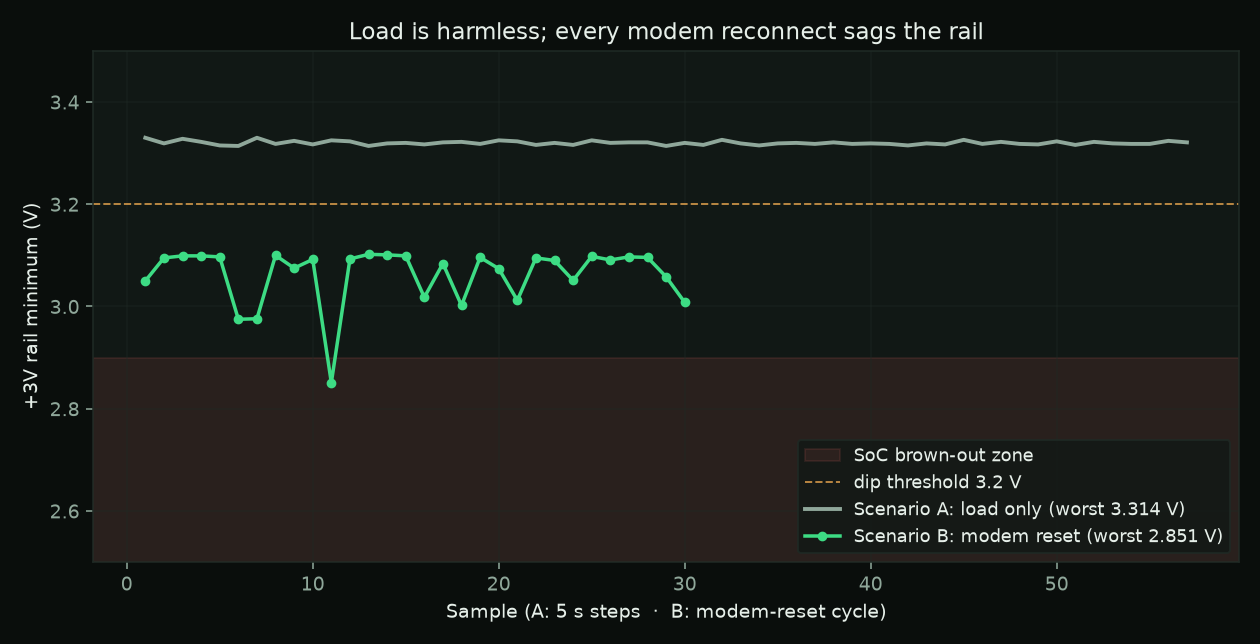
The result could not be more clear-cut:
| Scenario A (load only) | Scenario B (modem reset) | |
|---|---|---|
| Heavy CPU/IO load | yes | no |
| Antenna / RF reconnect | no | yes |
| Samples / cycles | 120 (10 min) | 30 |
| Dips below 3.2 V | 0 | 30 of 30 (100%) |
| Mean +3V minimum | ~3.32 V | 3.06 V |
| Worst +3V | 3.314 V | 2.851 V |
| Crash | none | intermittent |
Ten minutes of maxing out every core plus hammering both the eMMC and an external USB disk moved the rail by a few tens of millivolts — it never left 3.3 V territory. Meanwhile every single modem reconnect, on an otherwise idle CPU, pulled the rail hundreds of millivolts down, one cycle plunging to 2.851 V — deep into the brown-out margin. Load is a red herring; the modem’s RF re-registration inrush is the trigger.
The scripts
The whole experiment is small enough to share. A tiny library wraps the two
things I need: talk to the modem over its serial port, and read the rail minimum
off the Analog Discovery. Everything is parameterised by environment variables
(DUT_SSH, DWF_LIB) — no hosts, carriers, or paths baked in.
# rail_monitor_lib.py — shared helpers (excerpt)
import os, time, ctypes, subprocess, base64

DUT_SSH = os.environ.get("DUT_SSH", "root@device.local")
DWF_LIB = os.environ.get("DWF_LIB", "/Library/Frameworks/dwf.framework/dwf")
AD3_CH  = int(os.environ.get("AD3_CHANNEL", "0"))
RATE, BUF, RANGE = 100_000, 8192, 10.0

def ssh(cmd, timeout=25):
    try:
        r = subprocess.run(["ssh", "-o", "ConnectTimeout=8", DUT_SSH, cmd],
                           capture_output=True, text=True, timeout=timeout)
        return r.stdout.strip()
    except Exception:
        return None

def alive():
    return ssh("echo UP", 10) == "UP"

# The modem's AT port can move across reboots, so probe for an "OK".
_ATPORT_PY = r'''import os, termios, time, select
def probe(p):
    try:
        fd = os.open(p, os.O_RDWR | os.O_NOCTTY | os.O_NONBLOCK)
        a = termios.tcgetattr(fd); a[0]=a[1]=a[3]=0
        a[4]=termios.B115200; a[5]=termios.B115200
        termios.tcsetattr(fd, termios.TCSANOW, a)
        os.write(fd, b"AT\r"); time.sleep(0.4)
        buf=b""; end=time.time()+1
        while time.time()<end:
            r,_,_=select.select([fd],[],[],0.2)
            if r:
                try: buf += os.read(fd, 64)
                except: break
        os.close(fd)
        return b"OK" in buf
    except: return False
for i in range(8):
    if probe("/dev/ttyUSB%d" % i):
        print("/dev/ttyUSB%d" % i); break
'''

def find_at_port():
    b64 = base64.b64encode(_ATPORT_PY.encode()).decode()
    return (ssh(f"echo {b64} | base64 -d | python3 -", 30) or "").strip() or None

def modem_reset(port):
    """Full modem reboot: disconnect + reconnect (the RF inrush event)."""
    b64 = base64.b64encode(
        b'import os,termios,time,sys\n'
        b'fd=os.open(sys.argv[1],os.O_RDWR|os.O_NOCTTY|os.O_NONBLOCK)\n'
        b'a=termios.tcgetattr(fd);a[0]=a[1]=a[3]=0\n'
        b'a[4]=termios.B115200;a[5]=termios.B115200\n'
        b'termios.tcsetattr(fd,termios.TCSANOW,a)\n'
        b'os.write(fd,b"AT+CFUN=1,1\\r");time.sleep(1);os.close(fd)\n'
    ).decode()
    ssh(f"echo {b64} | base64 -d | python3 - {port}", 15)

class RailScope:
    """Read the +3V rail minimum from an Analog Discovery via the WaveForms SDK."""
    def __init__(self):
        self.dwf = ctypes.cdll.LoadLibrary(DWF_LIB)
        self.h = ctypes.c_int()
        self.dwf.FDwfDeviceOpen(-1, ctypes.byref(self.h))
        if not self.h.value:
            raise RuntimeError("AD3 open failed (close the WaveForms GUI first)")
        d, h = self.dwf, self.h
        d.FDwfAnalogInChannelEnableSet(h, AD3_CH, 1)
        d.FDwfAnalogInChannelRangeSet(h, AD3_CH, ctypes.c_double(RANGE))
        d.FDwfAnalogInFrequencySet(h, ctypes.c_double(RATE))
        d.FDwfAnalogInBufferSizeSet(h, BUF)
        self.sts = ctypes.c_byte(); self.rg = (ctypes.c_double * BUF)()

    def min_over(self, seconds):
        d, h = self.dwf, self.h
        t0 = time.time(); mn = 99.0; first = True
        while time.time() - t0 < seconds:
            d.FDwfAnalogInConfigure(h, 1, 1)
            while True:
                d.FDwfAnalogInStatus(h, 1, ctypes.byref(self.sts))
                if self.sts.value == 2: break
                time.sleep(0.0003)
            d.FDwfAnalogInStatusData(h, AD3_CH, self.rg, BUF)
            if first: first = False; continue   # discard settling buffer
            mn = min(mn, min(self.rg))
        return mn
Scenario A is then just: start the load, sample the rail, and never touch the modem.
# scenario_a_load_only.py (core)
import time, rail_monitor_lib as rl
BROWNOUT = 2.90

scope = rl.RailScope()
rl.push_load_helper()
loadp = rl.start_cpu_load()          # 4 cores, performance governor
iop   = rl.start_io_load()           # sustained dd write+read loop
worst, crashed, t_end = 99.0, False, time.time() + 10*60
while time.time() < t_end:
    mn = scope.min_over(5)
    worst = min(worst, mn)
    if not rl.alive():
        crashed = True; break
print(f"worst +3V = {worst:.3f} V, crashed = {crashed}")
# => 3.314 V, False  — load alone is not the trigger
Scenario B is the mirror image: no load, just reconnect the modem and watch.
# scenario_b_modem_reset.py (core)
import time, rail_monitor_lib as rl
scope = rl.RailScope()
dips, worst = 0, 99.0
for i in range(30):
    port = rl.find_at_port()         # re-detect; it moves across resets
    rl.modem_reset(port)             # disconnect + reconnect -> RF inrush
    mn = scope.min_over(6)           # capture the reconnect window
    worst = min(worst, mn)
    if mn < 3.20: dips += 1
    if not rl.alive():
        # brown-out crash: wait for auto-recovery (or cold power cycle)
        while not rl.alive(): time.sleep(5)
print(f"dips = {dips}/30, worst +3V = {worst:.3f} V")
# => 30/30 dips, 2.851 V — the modem reconnect is the trigger
That’s the entire proof: two short scripts, one variable each, a clean dissociation. The full, runnable versions live in the repo.
Reproducing the crash
One dip alone still wasn’t enough to crash the bench unit; it hovered around 3.0 V, marginal but alive. The field, though, doesn’t apply one stressor at a time. So I stacked them: heavy CPU + memory load running continuously, antenna attached, and back-to-back modem resets on top.
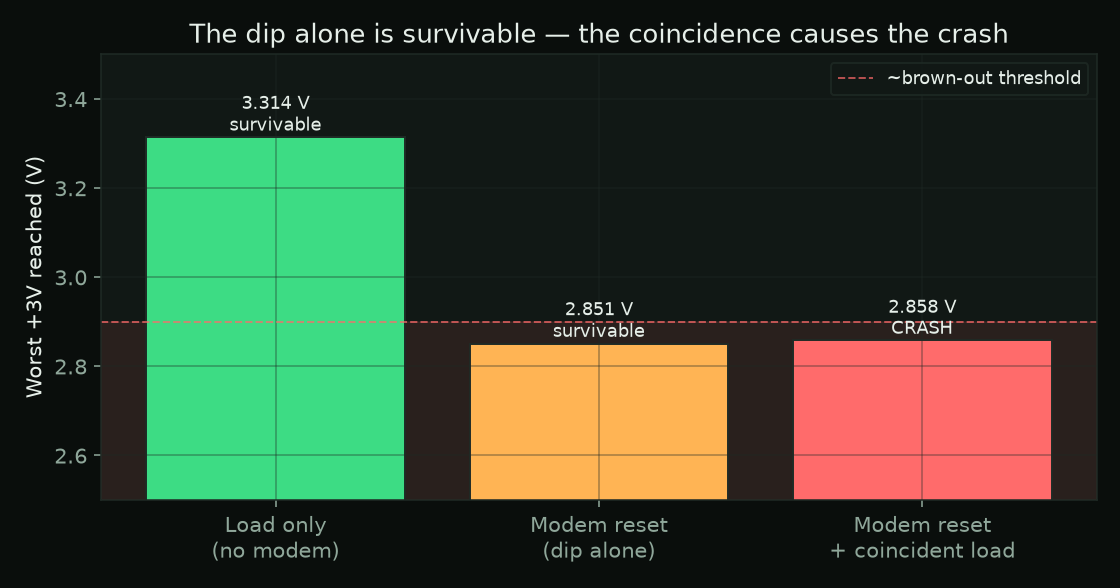
That did it. The +3 V rail brown-out to 2.858 V — and the board went unreachable. A hard crash. The serial console told the rest of the story: the kernel log simply stopped mid-line — no panic, no clean shutdown, just an instantaneous cutoff. That’s the signature of a brown-out reset, not a software fault.
And then it got interesting. The serial console showed a service starting up during recovery:
health-watchdog.service - Userspace health watchdog (reboots on brown-out zombie state)
The team had already met this ghost. Reading the script, it documents the exact failure mode in its own comments: during a brown-out, the kernel and PID 1 stay alive (so the hardware watchdog keeps getting petted and never fires) while the eMMC access path dies. Every disk read and every SSH login then fails — the unit is a zombie: powered, “up,” but functionally dead. That is the field’s “powers up, nothing happens.” On the next reset I even caught it halted at the GRUB menu, waiting for a keypress that, in the field, no one is there to press.
The whole chain, reproduced end to end:
thin +3 V design margin (every board) → 4G reconnect RF-TX inrush + a coincident operation → +3 V brown-out below ~2.8 V → eMMC path dies while the kernel lives → “zombie” / GRUB halt → “unusable, swap it.”
The tempting fix — and the lie
Here’s the idea that felt brilliant. If the damage is the eMMC getting hit mid-write during the brown-out, what if we quiesce the eMMC during the exact risky window — freeze the filesystem right before dialing the modem, hold through the inrush, then thaw?
It’s clean, it’s software-only, and fsfreeze is built for exactly this kind of
consistency window. I verified the modem still dials fine while /var is frozen
(the AT path is serial, no disk needed), wrapped it in a script with a hard
safety-timeout auto-thaw, and ran it under the same crash-inducing load.
Twenty cycles. Zero crashes. Where the unprotected board had crashed by cycle 4, the protected one sailed through. I was ready to call it.
Then I did the thing you’re supposed to do with a probabilistic failure: a controlled, interleaved A/B soak — protected and unprotected dials alternating under identical load, randomized order, enough cycles to mean something.
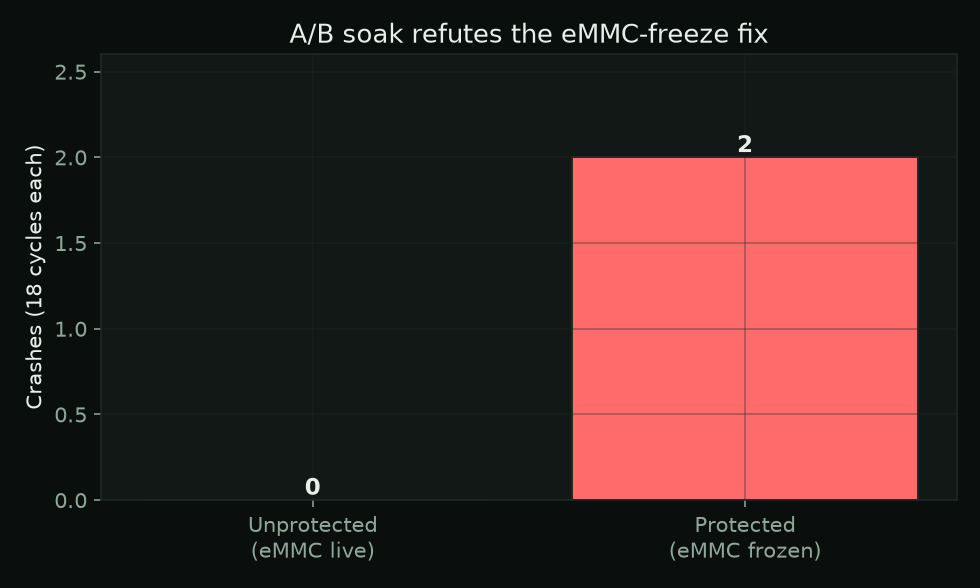
| Arm | Cycles | Deep dips | Crashes |
|---|---|---|---|
| Unprotected (eMMC live) | 18 | 1 | 0 |
| Protected (eMMC frozen) | 18 | 1 | 2 |
The protected arm crashed. Twice. The unprotected arm didn’t crash at all.
My beautiful 20-for-20 run had been luck, not causation. Once I gathered a fair sample, the mitigation evaporated — because it was aimed at the wrong layer. At ~2.8 V the SoC core itself brown-outs; the CPU and RAM lose voltage. You cannot protect a processor from losing power by freezing a filesystem. The eMMC “zombie” is a consequence of the brown-out, not its cause.
What was actually true
The root cause is electrical, not software, and it affects every board — not a worse-hardware subset. The +3 V rail is designed with too little margin: the modem-reconnect inrush (worse with a real transmitting antenna) drags it hundreds of millivolts down on any board. That dip alone is survivable. It becomes a brown-out crash only when it coincides with another current-drawing operation — a compute burst, storage I/O, a critical eMMC access — happening at the same instant.
That coincidence is exactly what the “5%” measures. Across 115 bench reconnect cycles (58 of which dipped), 4 tipped into a brown-out crash — ≈ 7% per dip, right in line with the field’s ~5%. In other words: in roughly one dip in twenty, the timing lines up and the board dies. It’s a rail sitting a hair above the cliff, pushed over only when the reconnect and some other work land together.
The only reliable fix lives in hardware — restore the +3 V margin fleet-wide with bulk/decoupling capacitance or a stronger regulator so the reconnect inrush, even stacked with a coincident operation, can’t reach the brown-out threshold. Software can reduce the odds of coincidence (quiesce the device around reconnect) and automate recovery, but it cannot prevent a processor brown-out.
The lesson I’m keeping
The eMMC-freeze idea taught me more than the fix would have. For a probabilistic failure, a single passing run is not evidence — it’s an anecdote wearing a lab coat. It took a boring, controlled A/B to separate a real effect from a lucky streak, and it saved a wrong fix from shipping to the whole fleet.
Measure the rail. Distrust the good result. Chase the ghost all the way down.
The code
The experiment is deliberately small and dependency-free so anyone can adapt it
to their own board. All host/carrier/path specifics are read from environment
variables (DUT_SSH, DWF_LIB), so nothing device-specific is baked in.
rail_monitor_lib.py— shared helpers: SSH, modem AT control (auto-detecting the port across reboots), and theRailScopewrapper around the WaveForms SDK.scenario_a_load_only.py— the load-only control (no modem reset).scenario_b_modem_reset.py— the modem-reconnect treatment (no heavy load).diag_load.py— the CPU + memory load generator.
Wiring: Analog Discovery CH1 (1+) on the +3 V test point, 1− and
ground on board GND. Run with the WaveForms GUI closed (only one process can own
the device), point DUT_SSH at your board, and the two scenarios reproduce the
dissociation above.
This write-up anonymises internal hostnames, addresses, the carrier, and proprietary service names; the electrical findings and methodology are presented as-is.